Cross World: Word Riddles
- 4.8
- Rating
- 500.00K
- Installs
- Free
- Price
 Analysis by App-foxy
I spent time with Cross World: Word Riddles as a casual word game that mixes crossword-style solving with trivia questions. That combination gives it a slightly different rhythm from a standard crossword app: I am not only looking for letter patterns, but also switching between vocabulary, general knowledge, and deduction. It is free to start, rated for Everyone, and made by Quiz & Trivia Games by Mno Go Apps.
The basic appeal is easy to understand. I can open it for a short mental break, solve a few clues, and stop without needing a long uninterrupted session. At the same time, the trivia angle gives each puzzle a little more personality than simply filling a familiar grid. The best reason to try it is the change of mental gears between word solving and recalling facts.
How the first goals shape the experience
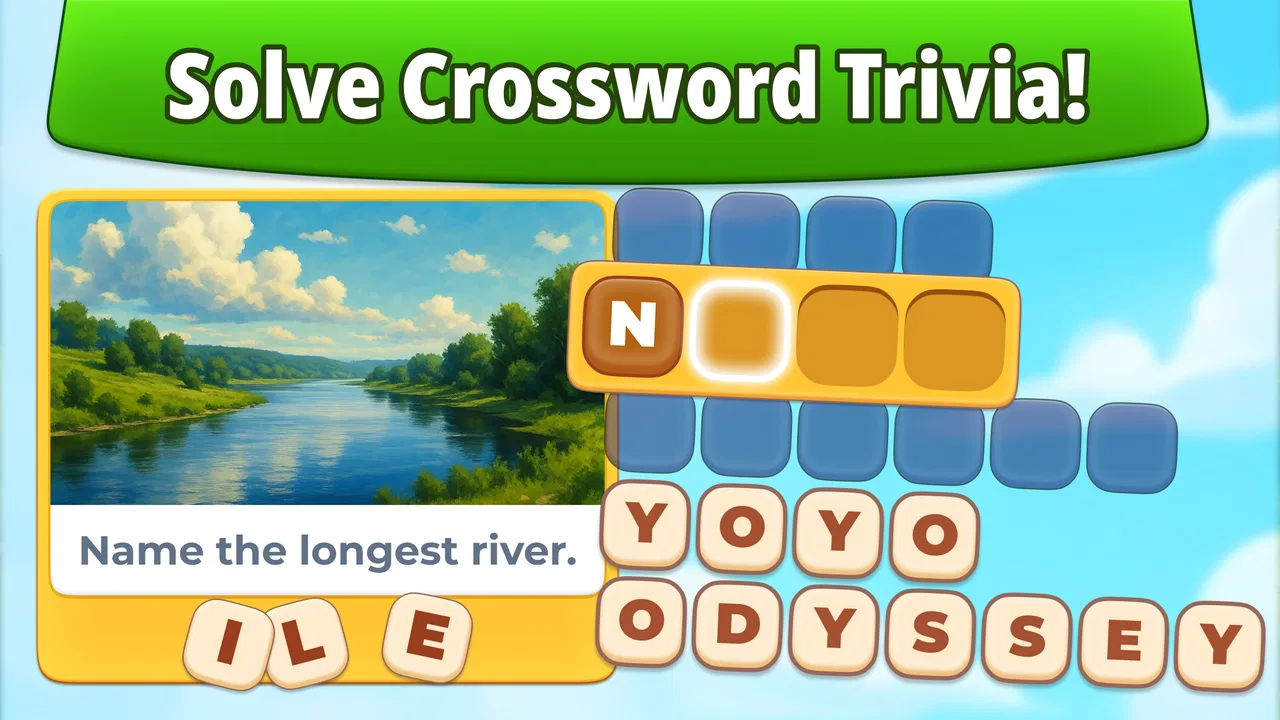
My early objective was straightforward: read the clues, identify likely answers, and use the crossing letters to narrow down the uncertain ones. That familiar structure makes the game approachable even if I do not normally play crossword puzzles. I never felt that I needed to learn a complicated control scheme before getting started.
You May Also Like

 Blood Strike: 2.5 Anniversary
Blood Strike’s Loadouts Turn Every Drop Into a Tactical Gamble
A close look at Blood Strike’s custom loadouts: how fast access to signature weapons reshapes its battle royale rhythm, rewards preparation, and narrows the gap between fights.

 Pandora - Music & Podcasts
Pandora’s Music Is Easy to Start, but Harder to Recover
Pandora’s strength is its low-effort path from a seed to a station. Its weak spot is how much confidence it asks you to place in connection, setup, and quiet recovery.

 8 Ball Pool
 Is Built on Rivalries, Rematches, and Routine
A close look at the rivalries, rematches, shared routines, and unanswered safety questions that turn a quick pool match into a persistent mobile community.

 Samsung Music
’s Quiet Strength Is Playing What You Already Own
Its reach comes less from spectacle than from dependable access to a personal library. That simplicity is both the app’s strongest retention engine and its ceiling.

 AccuWeather: Weather Radar
AccuWeather Review: A Quick, Clear Forecast for Everyday Decisions
For everyday plans, the best forecast is the one you can understand quickly. AccuWeather makes rain timing, radar, and local conditions easy to act on, with a few trade-offs.

 Hill Climb Racing
Why Hill Climb Racing Still Turns Crashes Into One More Run
A tiny car, a bumpy hill and one more upgrade: Hill Climb Racing keeps resurfacing because its simple chaos makes every near-miss feel personal.
More From Our News Desk



The first few puzzles also establish a useful habit. Rather than treating every clue as an isolated question, I learned to solve the answers I recognized immediately and then return to the harder spaces with more letters revealed. That is a small but important strategy, especially for players who are stronger at trivia than vocabulary, or the other way around.
For a new player, I recommend resisting the urge to guess every difficult answer at once. The crossing letters are more valuable when used as evidence. Solving the obvious clues first creates a clearer path through the rest of the puzzle and makes the game feel less like random guessing.
Because the game combines two familiar formats, it works well for several everyday situations. I can imagine playing it while waiting for an appointment, during a short commute as a passenger, or with a coffee when I want something more active than scrolling. It is also suitable for a family setting because the Everyone content rating makes it broadly accessible, although the trivia knowledge needed for a particular clue can still vary considerably from person to person.
The free entry point matters here. I can test whether the clue style suits me before spending anything. There are in-app purchases ranging from forty-nine cents to ninety-four dollars and ninety-nine cents per item, so anyone who enjoys the game should pay attention to the purchase flow and avoid assuming that every optional item is equally useful. The game itself is free, but that does not automatically mean every part of the experience has no cost.
Why the crossword and trivia pairing works
Traditional crossword apps usually reward pattern recognition, spelling, and patience. Trivia games tend to reward quick recall and broad knowledge. Cross World sits between those approaches. When I know the fact but cannot remember the exact spelling, the grid helps. When I recognize a partial word but cannot interpret the clue, the trivia angle gives me another way in.
That overlap is the game’s strongest design idea. A difficult clue does not always mean I am stuck permanently; it may simply mean I need to approach it through its crossing answers. Conversely, a player who normally relies on word patterns cannot always coast through without understanding the question. The two systems support each other without becoming identical.
The trade-off is that the experience may feel less focused than a dedicated crossword app. If I want carefully themed grids, highly precise clue construction, or a pure language challenge, a specialist crossword alternative may be more satisfying. If I want rapid-fire questions and immediate scoring, a conventional trivia game will probably feel faster. This title is better for players who enjoy the middle ground.
Progress signals, pacing, and the challenge curve
Progress in a word puzzle game is not only about reaching the end of a board. I also pay attention to smaller signals: recognizing clue patterns faster, needing fewer tentative answers, and knowing when to leave a blank space until the crossings provide more information. Cross World encourages that kind of gradual improvement because each solved answer can make another answer easier.
That creates a more satisfying loop than simply answering a list of unrelated questions. A trivia miss in isolation can feel final, while a missed clue inside a crossword still has several possible routes forward. I can make progress by solving neighboring entries, reconsidering the wording, or using the letters already available. The puzzle therefore rewards patience as much as memory.
The difficulty curve is best understood as a change in confidence rather than a single dramatic jump. Early success comes from familiar words and recognizable facts. Later, the challenge is often deciding which interpretation fits the available letters. That distinction matters: players who dislike being tested on obscure knowledge may still enjoy the deduction side, while players who want every answer to be instantly accessible may find the later puzzles demanding.
I found that the most efficient solving order is not always left to right. I scan for short answers, obvious definitions, and clues connected to several empty spaces. An answer with multiple crossings can unlock more of the board than a difficult isolated entry. This is one of the more useful ways to play deliberately instead of tapping through clues in sequence.
Another practical tip is to separate uncertainty about meaning from uncertainty about spelling. If I understand the clue but cannot remember the exact word, I treat the crossing letters as a spelling check. If I have several possible words but do not understand the clue, I stop forcing guesses and work elsewhere. Keeping those two problems separate reduces wasted attempts and makes the board easier to read.
That method also reveals a limitation. Players who prefer a completely relaxed experience may not enjoy the pressure created by a stubborn cluster of clues. Even without a timer being central to the appeal, an unsolved section can interrupt the pleasant flow of a short session. The game is casual in access, but the mental friction can still become serious when several answers depend on knowledge outside a player’s comfort zone.
When the challenge feels rewarding
The strongest moments come when a clue initially appears unrelated to anything I know, then becomes obvious after two or three crossing answers are in place. That kind of delayed recognition feels earned. I am not merely receiving a fact; I am reconstructing the answer from partial information.
The trivia component also changes how I judge mistakes. In a pure crossword, an unfamiliar answer can feel like a vocabulary gap. Here, it may be a knowledge gap, a wording issue, or a failure to notice the pattern in the grid. That variety keeps the challenge from becoming one-dimensional, although it can also make a loss of momentum harder to diagnose.
For younger players, the game can be a light way to practice spelling and recall, but I would not present it as a structured learning tool. Its main purpose is entertainment. Adults who enjoy general-knowledge quizzes may find the familiar questions comfortable, while players with narrower interests may encounter uneven difficulty depending on the subject of a clue.
What keeps a session going—and what may not
The retention appeal comes from the simple desire to finish the puzzle in front of me. Each solved answer creates a visible reason to continue because it reduces the remaining uncertainty. That is a more natural form of motivation than a purely abstract score: I want to see the grid completed and confirm that my interpretation was correct.
There is also a useful “one more clue” effect. A session can begin with a single answer, expand into several connected entries, and end only after a troublesome corner finally opens up. This suits short breaks because I can stop after a small amount of progress, but it also makes the game easy to return to later when I want to resolve an unfinished challenge.
Still, the long-term pull depends heavily on whether the clue variety remains fresh for the individual player. Someone who enjoys wordplay and broad trivia may find the combination naturally replayable. Someone who prefers narrative progression, character collection, competitive rankings, or a strong social layer may find the motivation too modest. I would not choose this game expecting the layered progression of a role-playing game or the constant novelty of a live multiplayer title.
The purchase range is another point worth considering for retention. A free game can be appealing precisely because it lowers the barrier to experimentation, but optional spending can change how comfortable the experience feels over time. My advice is to decide in advance whether I am treating it as a no-cost casual pastime or as a game where occasional purchases are acceptable. That simple boundary prevents a relaxing puzzle session from turning into an unplanned expense.
Device compatibility is fairly welcoming for older phones and tablets because the minimum operating system is Android six point zero. The current version is two point nine point zero one five, which is useful to know when checking whether an existing device can run it. I would still keep the game updated through the normal store process, since puzzle apps can benefit from fixes and content adjustments even when their controls are simple.
Who should choose it over the usual alternatives?
I would recommend this game to someone who likes crosswords but sometimes wants more context than a bare clue provides. It is also a good fit for a trivia fan who wants slower, more thoughtful solving instead of answering as quickly as possible. The hybrid format gives both types of player a way to use their strengths while exposing the weaker area to gentle pressure.
I would skip it if my priority is a deep crossword editor, a highly specialized vocabulary challenge, or a competitive quiz ladder. A dedicated crossword app will usually be the better choice for serious grid enthusiasts, while a focused trivia app will be more efficient for rapid question practice. Cross World earns its place when I want the two activities blended into one compact session.
It is less suitable for someone who becomes frustrated by uncertainty or expects every clue to have an immediate answer. The game’s satisfaction comes from filling gaps gradually. If I want a completely frictionless relaxation game, a simple word-matching title may be kinder. If I enjoy the moment when several partial clues suddenly make sense together, this format is much more rewarding.
My progression verdict
After looking at the goals, solving rhythm, challenge, and reasons to return, I see Cross World: Word Riddles as a focused casual word game rather than an all-purpose puzzle platform. Its progression works because each answer changes the state of the board, giving me a concrete next step. The game does not need elaborate systems to create momentum; the crossword structure itself supplies the immediate goal.
The developer, Quiz & Trivia Games by Mno Go Apps, has positioned it in a space that is easy to understand: a free word game for crossword and trivia fans. Its average rating is 4.8 from around 22 thousand ratings, and it has passed 100 thousand installs, which suggests that the concept has found a receptive audience. I treat those figures as useful context, not as a substitute for deciding whether this specific style of challenge suits me.
My honest view is positive, with a clear qualification. The combination is more interesting than a basic crossword clone, and the crossing letters make trivia questions feel less punishing than they would in isolation. However, the same blend can feel uneven when a clue depends on knowledge I do not have or when I want a more specialized puzzle experience.
The game is free, available for a broad age group, and easy to approach on compatible Android devices. That makes it a sensible download for a spare-moment puzzle habit. I would begin without paying, learn how the clues fit my interests, and only consider an in-app purchase after deciding that the ongoing solving loop genuinely earns a place in my routine.
In the end, I recommend it to readers who enjoy the small satisfaction of turning a few letters into a complete answer. It is not the right choice for every word-game player, but for me its strongest feature is the way progress feels earned: solve what I know, use the crossings intelligently, and let the difficult clues become manageable one step at a time.
FAQs for Cross World: Word Riddles
01What is Cross World: Word Riddles?
Cross World: Word Riddles is a puzzle game designed to challenge your vocabulary and problem-solving skills. Players must connect letters to form words and solve riddles. It's an engaging way to improve your language skills while having fun across various levels and themes.
02Is Cross World: Word Riddles free to play?
Yes, Cross World: Word Riddles is free to download and play. However, it offers in-app purchases for additional features, hints, and ad-free experiences. These purchases are optional, so you can enjoy the core gameplay without spending money.
03Does Cross World: Word Riddles require an internet connection?
Cross World: Word Riddles can be played offline, making it a great option for those who want to enjoy the game without an internet connection. However, certain features, such as leaderboard updates and in-app purchases, will require a connection.
04What age group is Cross World: Word Riddles suitable for?
Cross World: Word Riddles is suitable for players of all ages. The game is designed to be family-friendly, offering different difficulty levels to cater to both younger players and adults looking for a challenging puzzle experience.
05How does Cross World: Word Riddles handle data privacy?
Cross World: Word Riddles adheres to standard data privacy regulations, ensuring your data is secure. The game collects minimal user data for improving gameplay experience and ad targeting, and provides options to manage your data preferences in the settings.
Pros
- Engaging puzzles boost vocabulary.
- Smooth interface enhances user experience.
- Daily challenges keep gameplay fresh.
- Offline mode available for on-the-go play.
- Hints and tips help when stuck.
Cons
- Ads can interrupt gameplay flow.
- Limited lives can be frustrating.
- Some puzzles feel repetitive.
- In-app purchases can add up.
- Requires internet for updates.

Cross World: Word Riddles
Gallery